 Everything that happens in the world of food eventually gets to India.
It may take a little time to reach us but sooner or later our chefs come to grips with it.
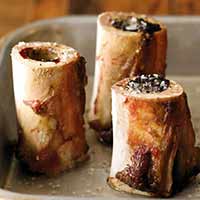
Eight years ago I wrote about bone marrow. We thought we knew about bone marrow, I wrote, but we were only used to goat marrow, a small quantity of which we were able to harvest from mutton bones. It was nice but not really my thing. My fascination was with beef marrow, great big chunks of a delicate jelly-like substance with a light ethereal taste that did not have the offal-pungency of liver or other organ meats none of which I can eat.
Marrow has been around for ever but it only became a staple of Western restaurant menus after the British chef Fergus Henderson popularised his version in which he oven roasted the marrow and served it with a little sea salt, sour dough toast and a parsley salad. Henderson’s version is still one of my favourite things to eat though when I interviewed him about it in 2012 he was modest enough to give the credit to Rowley Leigh, another influential British chef whose ideas had influenced the dish.
Anthony Bourdain fell in love with marrow, wanted it to be his last meal (which, sadly, it wasn’t) and championed Henderson’s style of cooking in the US. American chefs began doing even more interesting things with marrow and at New York’s three Michelin starred Le Bernardin, Eric Ripert (who is, of course, French) paired it with sea urchin, a marriage made in heaven.
The best bone marrow I had outside of the West was at 100 Mahaseth in Bangkok where the charcoal roasted version with perilla seeds became the signature dish of the chef Chalee Kader. I thought it would be hard for an Indian version to be as delicious till I had the marrow at London’s Hoppers.
The Hoppers version is called Bone Marrow Varuval. South Indians can argue over whether it is actually a Varuval (I think not but what do I know?)but Karan Gokani, the charismatic chef and food writer who runs Hoppers, has a very good recipe for it in his Hoppers: The Cookbook. Gokani calls it “the most popular curry at the restaurant. I reckon over the years we have had as many guests visit us for this dish as we have for our namesake hoppers.”
All of this begged the obvious question: why didn’t more restaurants make more marrow dishes in India?
The answer was obvious if you thought about it. By the time marrow became a global craze the anti beef frenzy had started in India. You couldn’t do much with goat marrow (best for Nalli Nihari etc) which was too small. The real thing remained a problem.
| "Western style marrow dishes now appear on lots of menus even if most chefs who cook Indian food are less willing to be as adventurous as Suresh and Hussain." |
The first Indian chef I know who got around that problem was Hussain Shahzad at Mumbai’s O Pedro. This was long before Hussain became a superstar with Papas and he was hardly ever written about in those days. Hussain had the bright idea of using buffalo marrow which offended nobody’s religious sensibilities and O Pedro, which was already my favourite restaurant in Mumbai became my regular marrow haunt.
In January 2019 I took Gaggan Anand and his kitchen team to O Pedro for dinner and they were hugely impressed by the chef, loved his take on marrow and invited him to Bangkok to cook with them.
Sadly the Pandemic intervened (as did Gaggan’s decision to open a new Gaggan) but by the time we emerged from COVID, Indian chefs were all in love with buffalo marrow.
Now it’s not difficult to find great marrow dishes. At Restaurant Chef Pillai in Cochin a Malayali spiced marrow dish is the star of the menu. It would be tempting to wonder if the eponymous chef-owner stole the idea from Hoppers but the truth is that Suresh Pillai was the original head chef of the Marylebone branch of Hoppers. He left London (where he had also worked with the Panjabi sisters for years) to come back to Kerala. He soon became the best known chef in Kerala and created a vast foodie empire.
I asked Suresh whether his marrow dish has any origins in traditional Kerala cuisine. He was honest enough to say that it was a modern innovation. They do use marrow in cooking in Kerala but they use it in gravies and curries not on its own. The exception, Pillai thinks, is a Muslim community near Wayanad which uses marrow from large bovine bones. But that, he said, is not where his own dish comes from.
Western style marrow dishes now appear on lots of menus even if most chefs who cook Indian food are less willing to be as adventurous as Suresh and Hussain. Will Aghajanian does two completely different marrow dishes at his two Mumbai restaurants: The Table and Kasper’s. Both are extremely popular.
In Delhi, Jamsheed Bhote and Hanisha Singh have long experimented with bone marrow at Plats the wonderful neighbourhood restaurant they run. Their bone marrow main course is outstanding.
I asked Jamsheed when he put marrow on the menu.
“The bone marrow has been on the menu for the past 6 months.” he responded, adding “We have used bone marrow in a crust over the tenderloin steak since the beginning of the restaurant 7 years ago. We toyed with the idea of serving the marrow as a small plate for a bit and then finally put it on the menu 6 months back.”
I suspect other chefs are also trying to work out how to put bone marrow on their menus. Indian chefs are good with goat marrow as an ingredient. At Nisaba Manish Mehrotra transform his raan with a bone marrow gravy. And at Raga Rydo Anton makes the world’s least oily Nalli Nihari with marrow.
But not many are ready to serve bovine marrow on its own. In Cochin Suresh Pillai first freezes the marrow and then oven roasts it for ten minutes - which is similar to Fergus Henderson’s technique. He has thought about cooking the marrow gently in a warm tandoor but still has to figure out how to ensure that it doesn’t melt.
I am sure he will work out the technique. Now that Indian chefs have come to grips with an ingredient it won’t be long before they master its complexity.
Name:
E-mail:
Your email id will not be published.
Friend's Name:
Friend's E-mail:
Your email id will not be published.
Additional Text:
Security code:
 Other Articles
-
Only five years ago I would have been stuck with Akasaka in Def Col. or Moti Mahal Deluxe in South Ex. Now I have amazing options to choose from.
-
In the pursuit of vegetarianism and vegetarian guests lies the future. And great profit.
-
I think that Indians have less desire to ‘belong’ than Brits do. We don’t need social approval. And this is a good thing.
-
And ask yourself: have I really been enjoying the taste of vodka all these years or just enjoyed the alcoholic kick it gives my cocktails?
-
There is a growing curiosity about modern Asian food, more young people are baking and the principles of European cuisine are finally being understood
See All